 Save the map
7 min, in Brian’s voice.
Tap a channel to read about it.
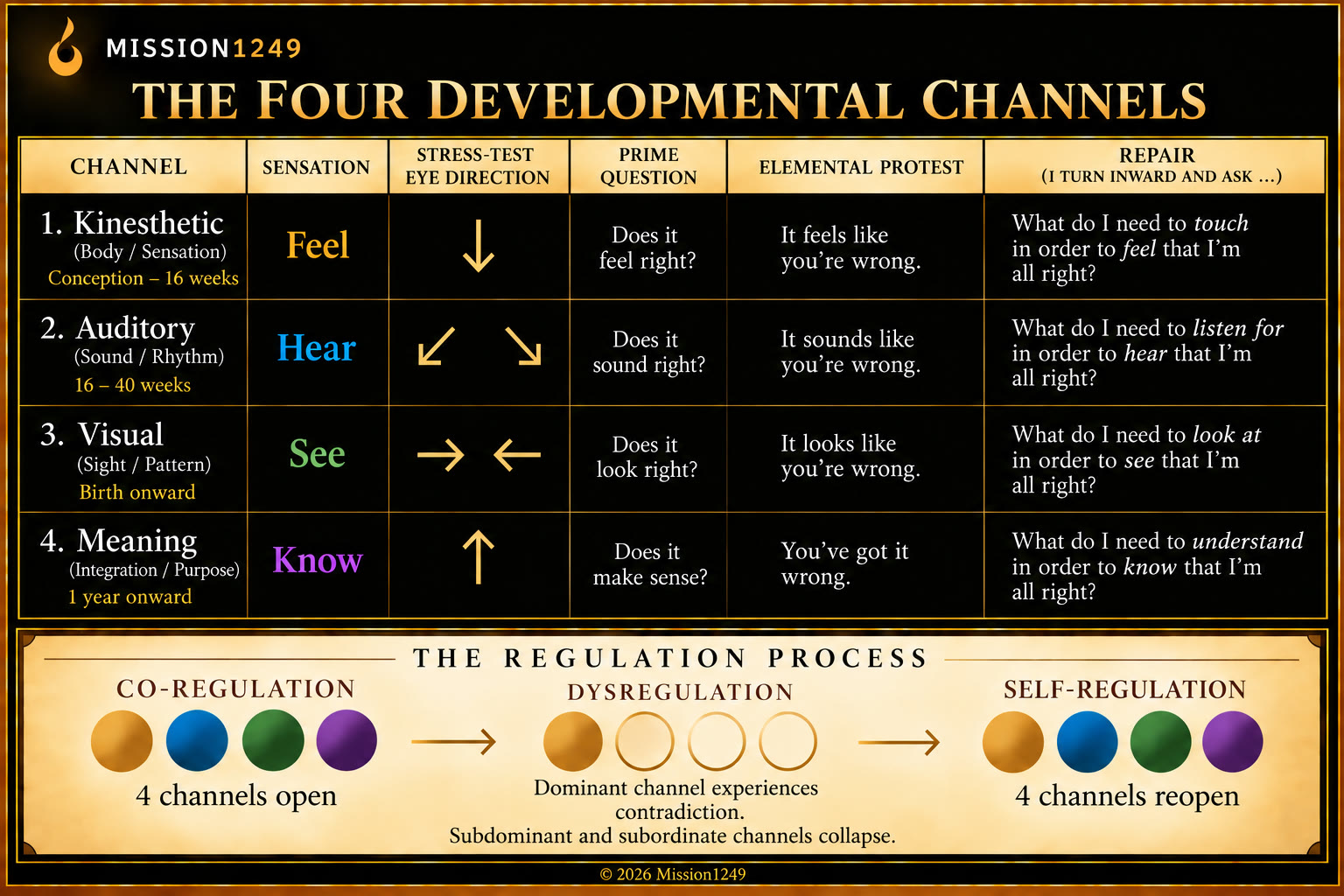
4 channels open
Dominant channel experiences contradiction. Subdominant and subordinate channels collapse.
4 channels reopen
What if it were possible to live with a deep and lasting sense of well-being?
Most of us know the opposite experience. We know what it is to be stressed. Anxious. Nervous. Unsettled. Something happens, someone says something, we see something we don’t like, or something simply doesn’t make sense—and suddenly we don’t feel all right anymore.
And usually, without even realizing it, we begin looking outside ourselves for the solution.
If this situation would change, I’d be all right.
If you would stop doing that, I’d be all right.
If you would speak to me differently, I’d be all right.
If things looked the way I expected them to look, I’d be all right.
But what if our well-being didn’t have to depend upon everything around us being all right?
That’s what this map is about.
Go all the way back to the beginning of your life.
Before you could think, reason, explain yourself, or even speak, you were already learning what it meant to be all right.
And you learned it in relationship.
In the womb and throughout early childhood, our well-being necessarily came through another person. We were held, touched, fed, spoken to, looked at, comforted and eventually helped to understand the world around us.
This is co-regulation. And there’s nothing wrong with it. It’s exactly what an infant needs.
But as we develop, four fundamental ways of experiencing the world begin to emerge:
We feel. We hear. We see. We understand.
I call these the Four Developmental Channels.
The first channel is Kinesthetic—the world of the body and sensation.
Before we can explain anything, our bodies are already registering experience.
Does this feel right?
When this channel is open, I can inhabit my body with a basic sense of well-being.
But when something happens that contradicts that well-being, I can very quickly move from “Something doesn’t feel right in me” to “It feels like you’re wrong.”
That’s the critical shift.
Something is happening inside me, but I begin looking outside me for its cause and its solution.
So the way back begins by turning inward:
What do I need to touch in order to feel that I’m all right?
Then there is the Auditory channel—the world of sound, rhythm and tone.
Long before a child understands the meaning of every word, they know the sound of a familiar voice. They know rhythm. They know tenderness and harshness in tone.
The fundamental question becomes:
Does it sound right?
But under stress, “It doesn’t sound right” can become “It sounds like you’re wrong.”
Now my well-being depends upon you changing your tone, changing your words, saying the right thing.
The movement toward self-regulation turns the question around:
What do I need to listen for in order to hear that I’m all right?
Then there is the Visual channel.
We begin taking in faces, expressions, movement, patterns and the world around us.
Does it look right?
And again, when this channel encounters something it cannot reconcile, “Something doesn’t look right” can become “It looks like you’re wrong.”
I begin trying to rearrange the world outside me so that I can recover the sense of well-being inside me.
Instead, I can learn to ask:
What do I need to look at in order to see that I’m all right?
And eventually there is Meaning—our capacity to integrate experience, understand it and make sense of our world.
Its question is:
Does it make sense?
This one is especially powerful because when something doesn’t fit the way I understand reality, it’s very easy to conclude:
“You’ve got it wrong.”
Again, my internal contradiction becomes an external accusation.
But instead of needing someone else to agree with me before I can be okay, I can turn inward:
What do I need to understand in order to know that I’m all right?
This is where the bottom of the map becomes important.
When we’re doing well, all four channels are open. We can feel, hear, see and understand at the same time. We aren’t trapped inside one way of experiencing reality.
But most of us have a dominant channel—the channel we rely upon most strongly.
Under stress, that dominant channel can experience a contradiction:
This doesn’t feel right.
This doesn’t sound right.
This doesn’t look right.
This doesn’t make sense.
And when that dominant channel experiences contradiction, the other channels can begin to collapse.
Now I’m no longer experiencing the fullness of what’s actually happening. I’m experiencing reality primarily through the channel that is telling me:
Something is wrong.
And very quickly:
Something is wrong with you.
That’s where projection begins.
As children, we needed someone outside us to help us return to well-being.
That’s appropriate to childhood.
But part of becoming an adult is learning that I don’t have to make you responsible for restoring me.
I can learn to recognize what’s happening inside me.
I can turn inward.
I can reopen the channels that have collapsed.
And eventually I can return to relationship not because I need you to change so that I can be all right, but because I am increasingly able to meet you from a place of freedom.
That’s the movement represented by this map:
Co-regulation → Dysregulation → Self-regulation.
The goal isn’t independence in the sense of “I don’t need anybody.” We are relational beings. We need one another.
The goal is freedom.
What if another person’s mood didn’t have to determine your well-being?
What if circumstances could change without taking your inner stability with them?
What if something could feel wrong, sound wrong, look wrong, or not make sense—and you could remain open enough to discover that reality is larger than what one channel is presently telling you?
That’s what it means to learn to keep all four channels open.
And perhaps that gives us another way of imagining maturity: a life increasingly free from chronic stress and anxiety because our well-being is no longer entirely dependent upon the people and circumstances around us.
Not a life in which nothing difficult happens.
A life in which difficulty no longer has the final word on whether I am all right.